by Bill Poole | Mar 17, 2022 | Sales

Originally published on April 19, 2019. Since we know a lot has changed since 2019, we’ve updated the article in 2022.
One of the best ways to grow revenue is to sell more to your current clients. My friend Mark Hunter likes to say, “You don’t close a sale, you open a relationship.” Once you get a new client (especially a new Ideal Client) the selling and marketing shouldn’t stop. With the right marketing and sales processes in place, your new clients can now become a source of additional revenue.
In order to get additional revenue from your current clients, you must earn the right. In this article, you’ll learn several ways you can do this.
ETR – Earn the Right!
This week I learned a great acronym: ETR! Earn the Right!
As sales professionals we must Earn the Right to further engage with our current clients.
On the Selling From the Heart Podcast, Larry Levine and I frequently discuss the difference between sales reps and sales professionals.
- Sales reps close deals and move on. Sales professionals open relationships and follow through.
- Sales reps suffer from low customer retention. Sales professionals enjoy long-term relationships with their clients.
How do you ETR? Here are a few ideas.
Know The Client’s Business Goals
If you’re smart, you’ll open every sales conversation by asking about the prospect’s business goals and challenges. These goals will form the basis for the value that you present. Not only will this help you win the deal, it will set the stage for adding additional value and thus selling more products and services. If you understand your client’s business goals and challenges, you can recommend additional products and services to help them achieve their goals. Every business has multiple goals and challenges. I’m willing to bet that you have additional ways you could help.
Regular Business Reviews
The vast majority of salespeople close a deal and then move on. The true sales professional goes back after the deal to review the progress. A Regular (I recommend Quarterly) Business Review provides a regular touchpoint where you can:
- Reconnect with the client’s goals and challenges
- Review your progress in helping them achieve their goals
- Resolve any issues (there are always issues!)
- Recommend additional ways you could help
- Request references
All of this begins with connecting to their business goals. As you earn the right to move from being a vendor to a partner you not only protect your base, you uncover additional opportunities in the account. As a bonus, you can ask for referrals.
Consistent Communication
Your clients know, like, and trust you for the core products you sell. They may not know about your additional solutions and services. You can certainly discuss these during QBR’s, but smart professionals take it a step further by making sure to always share new ideas. This can happen on your social profiles. It can also happen by sending helpful ideas to your clients.
For example, the other day, I saw an article that I knew would be interesting to one of my long-term clients. I took 2 minutes and emailed it to him. That article helped his business and also opened up a conversation about his net-new business development strategy. I now have an appointment tomorrow to talk to him and his VP of sales about implementing a Strategic Prospecting System!
Get Busy
Are you taking your current client base for granted? Stop! Your top ten clients are your competitions’ top 10 prospects. If you don’t take care of them, someone else will! If you do take care of them, taking the time to understand their business goals and challenges, there is a good chance you’ll earn the right to sell them more!
*This article originally appeared on LinkedIn Pulse on February 21, 2019. The article was updated on March 18, 2022.

by Bill Poole | Mar 14, 2022 | Sales, Strategy
Recently I talked with a business owner who had put all of their lead development into one particular source. Leads were streaming in—until the platform changed their rules. When that happened, new business came to a grinding halt. It took many months to ramp up a new strategy and the business suffered.
A strategy of leaning heavily into one source of leads is like buying stock in one company and putting all of your assets into that stock. No smart investor would do this. Yet, when it comes to leads for net-new business, this is exactly what many business leaders do.
Smart investors diversify their holdings, owning a mix of various types of assets. If circumstances cause the asset type to underperform the hope is that the others will pick up the slack.
Smart business leaders diversify their sources of net-new business. This ensures that if one lead source stops performing, others can pick up the slack.
At Convergo, we refer to sources of leads as Lead Channels. Think of multiple streams feeding into a river. If one stream dries up, the river still is fed from other streams.
The Lead Channel analogy is similar to the distribution model of many technology companies. A computer manufacturer typically has multiple channels including their direct sales team, channel partners, and retail. Inside each of these channels they have multiple types of channel partners and retailers. This diversification helps ensure consistent revenue.
What Are Lead Channels?
Lead channels are the sources of net-new opportunities for your business. Here are a few common lead channels to get you thinking:
Inbound Marketing
- Digital Advertising
- Organic Search Engine Placement
- Social Media
- Traditional Advertising
- Public Relations
- Events
- Podcasts
Direct Marketing
Outbound Selling
- Prospecting Sequences with Email, Phone, and Social
- Social Networking
- Lead Sharing Groups
Smart companies have a mix of lead channels.
If one of these works well, great! However, it is unwise to put all of your eggs in one basket, as they say. Smart companies diversify their Lead Channels.
What Keeps Companies From Diversifying?
Why do companies get stuck in the trap of one Lead Channel? Here are the two most common reasons I see.
The High-Performer
We have a tendency to double-down on high performing Lead Channels. If there is a particular strategy that works well for you, great! Just like you might want to put more of your investment portfolio into a high-performing stock class, it is smart to put more focus on a high-performing Lead Channel. The important thing is to not put all of your focus in this area. Sure, it is performing well right now, but that may not continue forever. Beware of the shiny object that takes your eyes of a diversified lead generation strategy!
Short-Term Thinking
Some Lead Channels take longer to develop than others. For example, a pay-per-click digital ad strategy might yield faster results than building organic placement in search engines or executing a social media strategy. Short-term thinking says, let’s go all-in on paid ads and forget about the long play. This mindset could keep you from enjoying the long-term fruit of an effective search engine and social strategy.
The Way We’ve Always Done It Around Here
For my friends in sales, “the way we’ve always done it” is a common reason to not diversify lead channels. I began my sales career 30 years ago in an industry that was all-in on face-to-face cold calling. We literally went door-to-door grabbing doorknobs, asking for decision makers, and collecting phone numbers to fuel phone prospecting later in the day. While this strategy worked well back in the day, over the past three decades many other potential lead channels have emerged with the maturity of the internet and mobile. Yet many companies in this industry still focus exclusively on field cold calls, refusing to diversify their Lead Channels.
Other industries have traditionally used billboards or TV advertising. Fantastic. However, billboards now exist in the form of digital advertising. TV advertising doesn’t just happen on NBC, ABC, CBS, and FOX. It also happens in a highly-targeted way on YouTube.
What You Can Do To Diversify
Whether you are enamored with a high-performer, trapped in short term thinking, or stuck in the way you’ve always done things, here are some steps you can take to diversify your Lead Channels.
Be Open-Minded
First, be open to new ideas. Experiment with new Lead Sources. Keep doing what’s working, but allocate some budget and attention to new things. A trustworthy sign that you might not be open-minded are the words, “Our prospects and clients would never…” Are you sure? We heard this a lot years ago about social media. Yet even my retired mom regularly visits Facebook and runs and Etsy store that gets leads through Google. Be open-minded.
Be Strategic
As you are being open-minded, don’t just jump on the next trend. Consider your Ideal Clients. Where do they spend their time? What outcomes are they looking for? What would be the best forum to engage in discussions? Use this to guide your diversification strategy.
For example, if your Ideal Client is a plant manager at a manufacturer, continue your sales prospecting efforts but consider how you might engage in additional strategies such as creating a podcast for plant managers, creating a group of similar companies that sell to plant managers, or doing digital marketing to a target audience of plant managers.
Strategy also means making some decisions that may not always look good on paper. For example, you might decide the get engaged as a sponsor for a conference or industry trade show. The cost-per-lead may be high, but the strategic benefits of exposure as a leader in your industry might need to be factored into that cost as well.
Be Smart
Track your Lead Channels. Where are new leads coming from? Which channels are performing well? For the ones that are underperforming, is there a long-term plan in play? If so, keep investing. If not, reallocate your dollars. For each Lead Channel, look at the revenue that came from that channel and determine the revenue that resulted and the cost-per-lead.
Diversifying your lead channels takes work. In today’s rapidly changing marketplace, this work will pay off. While your competitors are left scrambling and trying to pivot, you’ll keep moving forward.

by Bill Poole | Feb 14, 2022 | Sales
Metrics are nothing new to successful entrepreneurial businesses. Metrics typically flow throughout the operations and finance departments and drive client satisfaction and business growth. For whatever reason, these same businesses have a hard time inputting and tracking the right sales metrics.
3 traps to avoid when selecting the right sales metrics are:
- Failing to consider the quality of the prospect
- Starting from the beginning
- Not considering the big picture.
Failing to consider the quality of the prospect
Quality prospects, or Ideal Prospects as we like to call them, are the ones that can buy everything that you sell and that your operational team is optimized to serve. Given the fact that they can buy everything that you sell, it takes fewer Ideal Prospects to reach your revenue goals.
Using metrics like # of proposals given, # of demos without weighing the quality of the opportunity can be unhealthy for the business. If a sales rep is expected to deliver X number of proposals, then they may chase opportunities that would turn into headaches for your operational teams to serve downstream.
Working with a prospect to the point of delivering a proposal is very time consuming and, depending on the internal resources used, potentially very expensive. If the quality of the prospect is taken into consideration towards the top of the funnel, suboptimal opportunities are qualified out early on. Then, the sales team can focus more on turning Ideal Prospects into Ideal Clients that your team will be happy to bring onboard.
Starting from the beginning
As Stephen Covey penned: Start with the end in mind! Developing random sales metrics that are not connected to the revenue goals of the business is a mistake. As we just established, it is easier to meet your revenue goals by focusing on bringing on Ideal Clients/Prospects. So, how many Ideal Prospects do you need to hit your revenue goals? That is a good place to start!
From there, work your way backwards through the sales cycle/funnel and you should be able to determine the lagging, leading, and activity metrics that you should be tracking.
Not considering the big picture
Reducing the amount of time it takes to close an Ideal Prospect can have dramatic results. Removing friction that prospects have as they navigate their buying experience is the key to doing this.
In order to see where the most friction exists, you need to have metrics in place throughout the entire prospect experience/sales process. That way, you know where you need to take action to remove the friction.
Conclusion
If you are able to avoid these 3 traps, the effect on the business can be enormous. In the end:
- It will take you fewer Ideal Prospects to meet your revenue goals.
- It should take you less time and effort to win business. Yes, this might mean you need fewer sales reps as well!
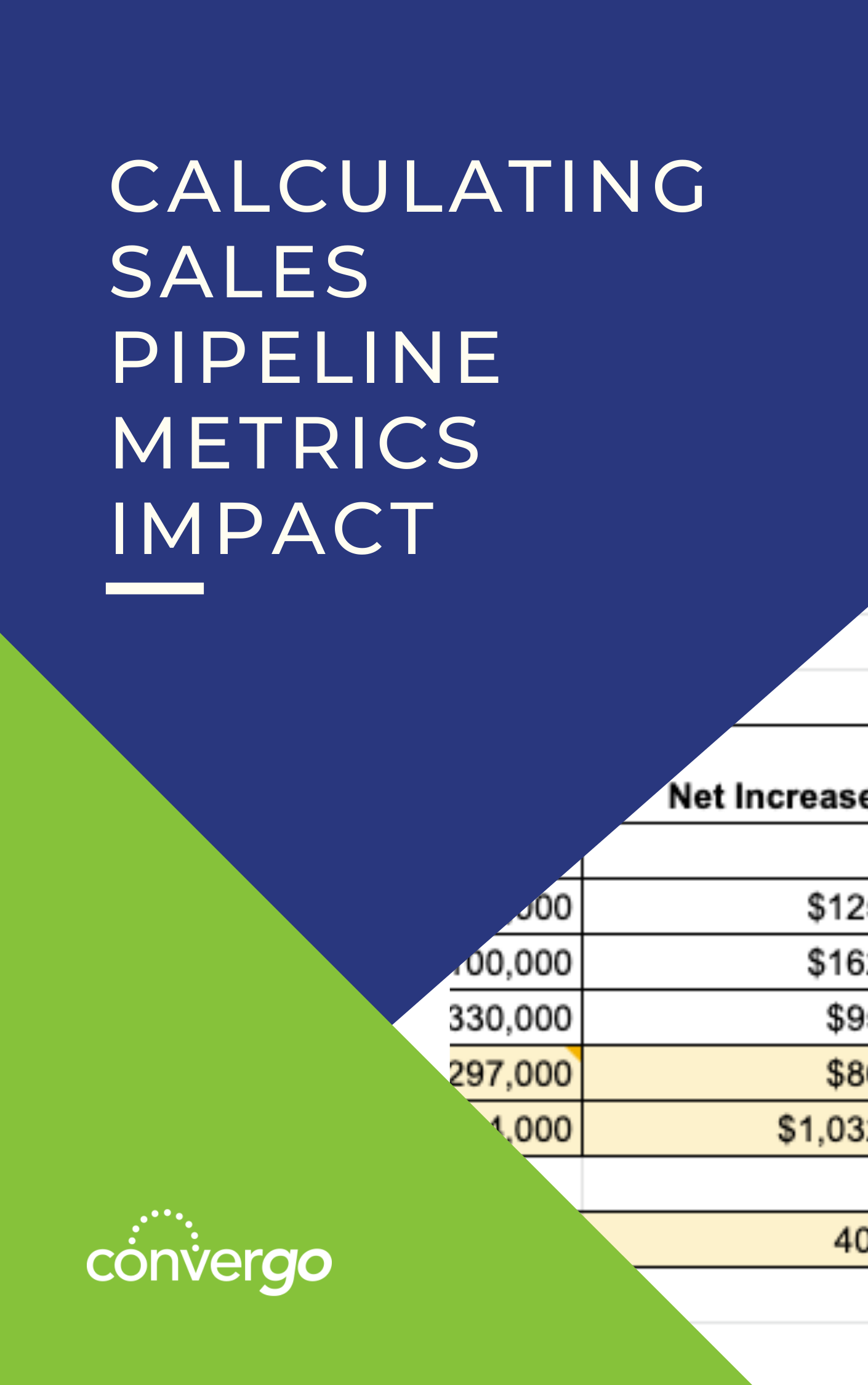
How effective are your sales metrics? Download the Sales Pipeline Metrics Impact Worksheet to calculate the impact of improving your conversion rates.

by Bill Poole | Feb 1, 2022 | Resources, Sales
Originally posted by Darrell Amy on LinkedIn.
When it comes to revenue growth, most companies focus on the total revenue goal. Doing this usually ignores a critical driver of revenue: cross-sell revenue. The goal for cross-sell should be 100% sold.
Most companies do a reasonable job at landing new clients. The majority of companies struggle at expanding inside their base. With marketing focused on generating leads and sales focused on closing net-new business we have a tendency to land new deals and then walk away.
My first real sales job was with a company that drilled into my head the concept of 100% sold. A client becomes 100% sold when they are taking advantage of all of the products and services your company offers. As marketing guru Jay Abraham would say, “You want all of our clients to get the best and highest value from your company.”
100% Sold: What percentage of your clients own all of your products and services?
As I lead Revenue Growth Workshops across multiple industries the common trend is that companies tend to focus expectations on marketing and selling their core product. Little attention gets placed on new products and supporting offerings.
Too many companies have only paid lip-service to cross-selling more products and services to their current client base. As a result, low-hanging fruit sits rotting on the vine. Even worse, smart competitors that grab that fruit can use their relationship with your customer to displace you from the account.
100% sold should be tracked on three levels:
1. Company Wide
What percentage of your client base owns each of your product and/or service categories? You may have a core product that 100% of your clients own. Then, you may have a service offering that 25% of your clients own. You may have a secondary product offering that 10% of your clients own. Company dashboards should include the percent of clients that own each of your products. 100% sold should be a topic in every company meeting.
2. By Sales Rep
How well is each rep doing at 100% sold across their client base? Measuring reps by the percentage of their clients that use each product and service keeps the focus on cross-selling. If a given rep is underperforming in selling a product or service category their development plan can include learning how to sell that service. Bonus structures can be configured based on 100% sold metrics. Stack rankings can be presented by 100% sold.
3. By Client
For any given client, what percentage of your product and services offering do they own? If you have four lines of business and your client only has one line, they are 25% sold. They may be a big client for that one line of business but they are still only using 25% of your products and services. Account reviews with marketing (yes, I said marketing) and sales can include developing strategies to get to 100% sold. This is especially fruitful for your Ideal Clients.
How To Get To 100% Sold
It’s time to get serious about cross-selling. In Revenue Growth Engine I present marketing and sales processes that can be leveraged to cross-sell. There are many processes you can build to align marketing and sales around this goal.
The first step, however, is to set the goal of 100% sold and track the progress. Whether you own a company, lead a revenue team, or work in sales, you can put this to work right away.
Executives
Get your copy of Revenue Growth Engine. In the book, I unpack the concept of 100% sold and offer key marketing and sales processes you can put into place to maximize revenue by driving toward 100% sold.
Sales Leaders
Develop the account management sales skills to drive 100% sold with the Authentic Client Management program, part of the Trust-Building Series from Selling From the Heart.
Sales Professionals
You don’t have to wait for your company to set your own 100% sold goals and build the skills to execute. Join the Client Management part of the Trust-Building INTENSIVE from Selling From the Heart to begin enjoying the low-hanging fruits of 100% sold.

by Bill Poole | Jan 31, 2022 | Sales, Strategy
When faced with a price increase, clients may feel backed into a corner with only two options. One option is to take the price increase, sacrificing somewhere else in their budget. The other option is to stop buying from you and either forego the service or go through the hassle of finding another vendor.
Price increases typically create a “yes” or “no” scenario. Instead, what if you offered a third fallback option that was a scaled back version of your service?
Your fallback option could be lower-cost package with fewer benefits for your clients that are not willing to accept the price increase. You win because you keep the client. The client wins because they get to save money while keeping pieces of your offering.
The good news is that your fallback option not only can preserve revenue, it may also be able to preserve your profits. Done correctly, it may also create a strategy to go after your competition and get marketshare.
Here are a few things to consider as you create your fallback option.
Ask What Is Essential To Your Customers
When I was a kid most of the cars we had growing up had an AM radio, bench seats, and windows that you rolled down by hand. Now my car has an incredible surround-sound stereo system, multi-position heated buckets seats, and automatic windows. As much as I like these amenities, the reality is that I mainly need my car to get me to the airport and back. If cost-cutting were necessary, I could live without the fancy things.
Think about your products and services through the eyes of your customers—especially the ones who tend to be price-sensitive. What is most important to them? What can they not live without? What challenges are they facing that your offering alleviates?
Bob Moesta and Clay Christensen believe that buyers don’t buy products and services. Instead, they hire them for a “job to be done.” In the case of my car, I mainly hired it to get from point A to point B. Sure, I also hired it to provide some comfort, enjoyment, and status. But if times are tight what I mainly need is transportation.
Think about your offerings. What “job to be done” did your customers have that motivated them to purchase from you? What is essential and what is optional?
Your fallback option should include the essentials. In fact, you might even call it your “essentials” package. Strip away the surround sound, heated seats, and automatic windows. Offer a lower-cost option that still gets the job done. This allows you to keep your client while becoming a partner that also helps them achieve the goal of reducing their costs instead of raising them.
Consider You How You Can Preserve Your Profits
Just because you offer a fallback option with a lower cost does not necessarily mean that you need to lower your profits. Look for ways to package your “essentials” option in a way that has the same profit as your full offering.
Once you create your “essentials” bundle look at the cost of the product and/or service.
Then, take the actual dollar amount of the margin you had on your full offering and add it to the essentials offering. If you use this as the price you can protect your profit.
Can you always protect your profits? No. However, sometimes you might find a way to even raise your profits.
Create a Campaign To Add Back Margins
For the customers that choose your fallback option instead of a price increase, build a marketing campaign that allows them to add back some of the options. You might let some time pass. Then start dripping out marketing that lets them add in features. Make it easy to bring these back in.
For example, my TV provider recently raised their rates. If they had a fallback option, I might have opted for fewer channels to save some money. Over time, the provider would be smart to begin offering some of the channels I lost for an incremental increase in monthly fees.
You might be able to do the same. After some time has passed, launch a marketing campaign that invites clients to incrementally upgrade their experience with your company.
Go After Your Competition
As you create your fallback option you may discover a new offering that could attract customers from your competitors. Chances are your competitors are raising prices. Your “essentials” offering could be the thing that lures them away. Once you bring them on board you can expand the relationship.

by Bill Poole | Sep 14, 2021 | Sales
Does this sound familiar to you: Your company’s monthly sales results look like a roller coaster at Six Flags. You’re up one month, then down the next. You have a great quarter, and then the next you drop off. Why do we experience the roller coaster ride with crazy peaks and valleys in our sales results? In this blog, we’ll talk about how you can create a more predictable sales funnel that is more consistent and has shallower valleys.
The Problem
At its core, peaks and valleys in your sales funnel point to a lack of consistency. There isn’t a consistent stream of sales coming in, which means that your monthly numbers are all over the place and it’s hard to predict where you’ll be at the end of the quarter, year, etc.
The Culprit
We believe that this problem stems from a lack of consistent processes in both sales and marketing. One example of what this ends up looking like is that your sales reps may do seasonal prospecting. In January, everyone’s out pounding the pavement and getting prospects and then they have a great March because those orders from January finally closed. It may appear like the reps have been doing great work from January through March, when really they may have stopped prospecting at the end of January. So then they’re gonna have a bad April and May because they stopped prospecting months ago and the top of their funnel dried up. They’ll start their prospecting back up in April and May and have a good June.
This same issue happens with marketing as well. What happens if you aren’t consistent with your marketing efforts? For example, if you invest a bunch in Google ads and have a big campaign, you may rake in a bunch of leads. Then once you turn off your ad campaign, the leads dry up. The lack of consistency means that the leads come in spurts, rather than flow in.
Consistent Processes
Let’s talk about consistency and processes. At Convergo, we like to think that these two things go hand in hand. When things are happening consistently, you can turn them into formal processes. These processes should be trainable and optimizable. It’s crucial to put these repeatable processes in place because it sets you up for reflection, analysis and improvement. One big thing tha t we are driven on at Convergo is ensuring that companies have processes in place for net-new business, to make sure that your funnels don’t feel like a roller coaster, but rather a steady climb up and to the right towards your revenue targets.
If you implement consistent, well-documented processes that are expected and inspected and managed, then it can really even out those peaks and valleys.
Metrics Lead to Predictability
Increasing metrics are obviously a positive sign when it comes to sales and marketing. This can also be a valuable tool when adjusting any type of process within your business. Let’s say you know the clear gates between each stage of your pipeline and the conversion rate between one stage and the next is 50%. This allows for a more accurate adjustment because you have an actual number to go off of. It’s an easier way to keep an eye on the metrics that are doing well and those that are not. Check out this blog post for a better idea of sectioned “gates” within the sales process.
Once you have clear processes you can measure two things: quantity and quality.
How often are your team members executing your processes and the activities at each step? How often does a prospect make it from one pipeline stage to the next? You have two things to consider once a process has been established and those are quantity and quality. It’s critical in sales that every aspect becomes a process because then you can actually count it and measure it, and then you have something that you can optimize. Always ask yourself what’s working and what isn’t really working. You want the roller coaster feeling of going up and up. Keeping up with the quality of those conversion rates is key. Without that quality, you’re probably going to be stuck on that roller coaster going up and down.

Progress, Not Perfection
So where do you begin? Maybe you have some activities happening consistently. Maybe you have a couple of formal, documented processes. Maybe you have a couple team members that are very effective and consistent.
One easy thing to get started is to pool all of your resources. Figure out which person is doing really well at each activity that needs to happen and figure out how you can turn what they are doing into formal processes that can be repeated by the rest of your team members. Basically, who is achieving very well in each stage and how can you replicate what they’re doing. Give all of your team members the knowledge and resources they need to have the same success.
Since you are now setting out to create repeatable and clear processes, you can now hold your team accountable. You may be able to have a measurable for each team member that you can coach them on now. For example, if the average conversion rate on your team between stage 1 and stage 2 is 50% and you have a rep who’s converting at 20%, it’s clear what you need to coach that rep on. If the average activity on a given stage is 20 per day, and you’ve got a rep that’s doing 5 per day, you have a coachable opportunity there. When you have repeatable processes, you end up with clear numbers that help you pinpoint coachable opportunities to help your team.